
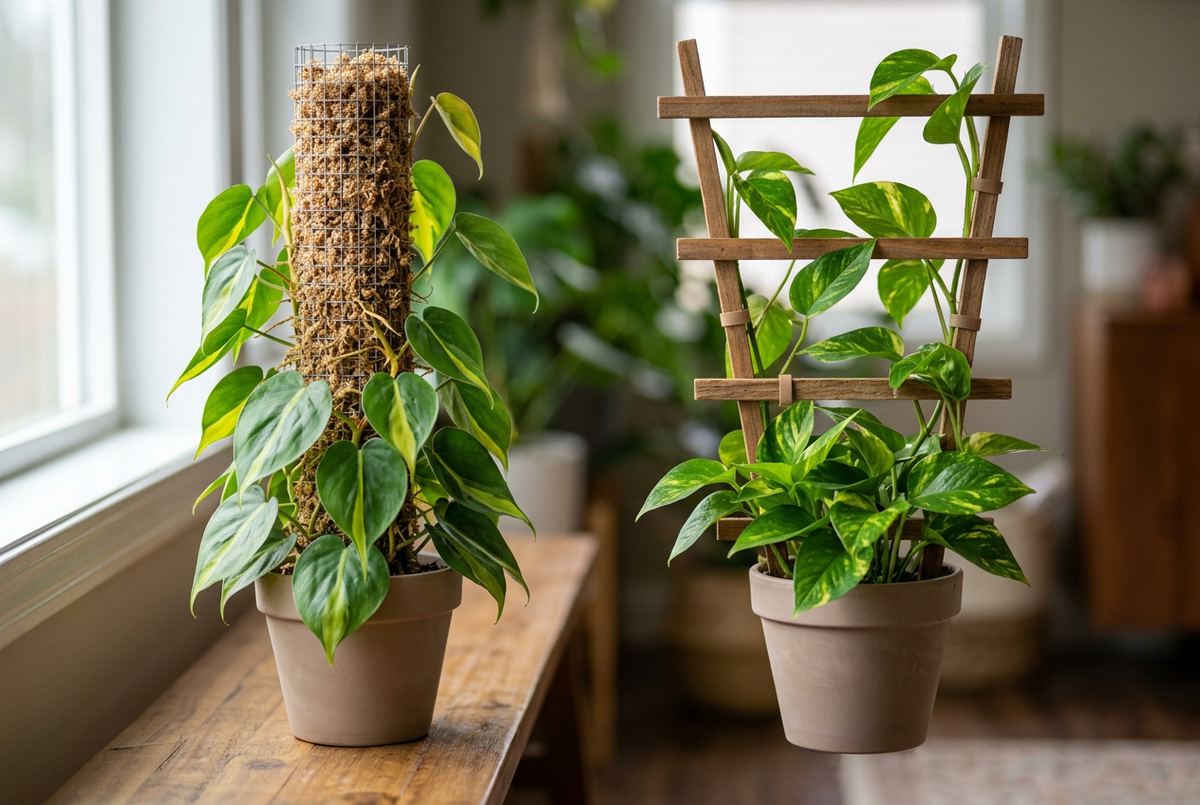
Moss Pole vs Trellis: Which Is Better for Climbing Plants?
Have you ever wondered why some Monstera and Philodendron plants develop enormous leaves while others keep producing smaller foliage? Or why some Hoya collectors prefer trellises while others grow their plants on moss poles?
The secret may be in how you support your climbing plants.
Many tropical houseplants naturally grow upward, attaching themselves to trees or other surfaces. When grown indoors, these plants may benefit from structures that support their natural growth habits.
Two popular options are moss poles and trellises. But which one is better?
The answer depends on your plant, its growing habits, and what you want to achieve. If you're hoping for larger leaves, a beautiful climbing display, or a more organized indoor plant collection, understanding the difference can make plant care much easier.
In this guide, we'll compare moss poles and trellises, explain their advantages and disadvantages, and help you choose the best support for your Monstera, Philodendron, Hoya, Scindapsus, and other tropical plants.
What Is a Moss Pole?
A moss pole is a vertical plant support made using moss or another fibrous material around a central structure.
Its primary purpose is to give climbing plants something to attach to as they grow upward.
Many tropical aroids naturally climb trees using aerial roots. A moss pole can provide a similar vertical surface in an indoor growing environment.
How Does a Moss Pole Work?
When a climbing plant produces aerial roots, those roots may attach to suitable surfaces.
A sphagnum moss pole can retain moisture, allowing certain plants to develop roots into the moss when it is maintained appropriately.
As the plant climbs and matures, some species may begin producing larger leaves or more mature leaf shapes.
However, a moss pole alone does not guarantee larger leaves. Lighting, maturity, root health, and overall growing conditions are also essential.
Types of Moss Poles
Sphagnum moss pole: Made with moisture-retaining sphagnum moss, often held inside plastic mesh or a similar structure. It provides a surface where aerial roots can establish when moisture is maintained.
Coco coir pole: Made using coconut fibers wrapped around a support. It provides a textured climbing surface but generally holds moisture differently from sphagnum moss.
Modular moss pole: An extendable structure that allows additional sections to be attached as the plant grows.
Although coco coir poles are sometimes marketed as moss poles, they do not function exactly like a moist sphagnum moss pole.
What Is a Trellis?
A trellis is a structure designed to support and guide climbing or vining plants.
Trellises can be made from metal, wood, bamboo, plastic, or other suitable materials.
Unlike a moisture-retaining sphagnum pole, a typical trellis primarily provides structural support rather than a rooting medium.
How Does a Trellis Work?
As a plant grows, its vines can be guided around or secured to the trellis.
This helps keep long stems organized and allows growers to create attractive plant displays.
Some plants naturally twine around supports, while others need gentle ties to hold their stems in place.
Trellises come in different shapes, including:
-
Circular hoops
-
Heart-shaped frames
-
Wooden ladders
-
Metal grids
-
Arched supports
-
Flat decorative panels
-
Larger vertical structures
They are especially popular for Hoyas and other vining plants grown for decorative foliage and flowers.
Moss Pole vs Trellis: What's the Difference?
The biggest difference is how each support interacts with the plant.
A moss pole can provide both structural support and a surface for aerial roots to establish.
A trellis primarily supports the stems and controls their direction of growth.
Here are the main differences:
-
Root attachment: Moist sphagnum poles can encourage aerial roots to grow into the support. Most trellises don't provide the same moisture-retaining rooting surface.
-
Leaf development: Climbing aroids may benefit from suitable rooting support as they mature, while trellises mainly provide physical structure.
-
Maintenance: Moss poles may require additional watering and monitoring. Trellises generally need less maintenance.
-
Appearance: Moss poles create a natural vertical growing structure, while trellises allow decorative shapes and arrangements.
-
Plant suitability: Moss poles are often useful for climbing aroids. Trellises are particularly convenient for many Hoyas.
Neither option is universally better. The right choice depends on the plant's natural growth habit.
1. Which Support Helps Plants Grow Bigger Leaves?
If your goal is to encourage larger leaves, a suitable moss pole can be particularly helpful for some climbing aroids.
Plants such as Monstera and certain Philodendrons naturally develop different foliage as they mature.
In the wild, climbing plants may establish themselves on tree trunks and grow toward brighter areas.
When provided with appropriate support indoors, some species may gradually produce larger, more mature leaves.
Why Can a Moss Pole Help?
A properly maintained sphagnum moss pole may allow aerial roots to establish into the support.
This helps replicate part of the plant's natural climbing behavior.
The plant can become better supported as its stem grows vertically.
For some climbing aroids, this is associated with more mature leaf development.
Can a Trellis Make Leaves Bigger?
A trellis can support healthy climbing growth, but it usually doesn't provide the same rooting environment as moist sphagnum moss.
However, a suitable trellis, wooden plank, or other firm support may still help certain plants develop more mature foliage.
Important: A moss pole isn't a shortcut to giant leaves. Healthy roots, adequate light, nutrition, genetics, and plant maturity are equally important.
2. Which Is Better for Monstera?
Monstera is one of the most recognizable climbing houseplants.
In tropical environments, many Monstera species use aerial roots to attach to trees.
As some species mature, their leaves can become larger and develop characteristic splits or holes called fenestrations.
Moss Pole for Monstera
A moss pole can be an excellent choice if you want to encourage natural climbing growth.
Potential benefits include:
-
Vertical support
-
Aerial root attachment
-
Better support for heavy vines
-
More organized growth
-
Encouragement of mature foliage under suitable conditions
For large Monstera deliciosa plants, choose a sufficiently sturdy structure that can safely support the plant's weight.
Trellis for Monstera
A trellis can also support Monstera vines, particularly smaller plants or species that are easier to train.
However, a lightweight decorative trellis may not provide enough support for a large, mature Monstera deliciosa.
Our recommendation: For climbing Monstera grown with the goal of producing large, mature foliage, a sturdy moss pole, wooden plank, or comparable vertical support is often a good choice.
3. Which Is Better for Philodendron?
Philodendron is a diverse plant group with climbing, crawling, and upright growth habits.
Choosing the correct support requires understanding the particular species.
Climbing Philodendrons
Climbing species such as Philodendron melanochrysum, Philodendron hederaceum, and Philodendron hastatum can benefit from vertical support.
For these plants, a moss pole may help aerial roots establish and encourage mature climbing growth.
Crawling Philodendrons
Some Philodendrons, such as Philodendron gloriosum, naturally grow horizontally.
These plants are generally better suited to wide containers that allow their stems to crawl.
They do not need a moss pole simply because they belong to the Philodendron genus.
Self-Heading Philodendrons
Some cultivated Philodendrons have compact or upright growth habits.
These may need little support or only a stake for stability.
Our recommendation: Use a suitable moss pole for climbing Philodendrons when encouraging mature growth. For crawling Philodendrons, prioritize horizontal growing space.
4. Which Is Better for Hoya?
Hoya is one of the most popular tropical plant groups among collectors.
Many Hoyas naturally climb or trail, producing long vines and beautiful foliage.
Some species also produce fragrant, star-shaped flowers.
Unlike many climbing aroids, Hoyas are often grown primarily for their ornamental vines, interesting leaves, and flowering characteristics.
Why Many Hoya Collectors Prefer Trellises
A trellis allows growers to guide Hoya vines into a neat and attractive shape.
Circular hoops, metal frames, and small ladders are popular choices.
Benefits include:
-
Organizing long vines
-
Creating attractive displays
-
Keeping plants compact
-
Supporting twining stems
-
Making plant placement easier
-
Displaying foliage and flower clusters
A trellis can be particularly useful for Hoya carnosa, Hoya pubicalyx, Hoya australis, and other climbing varieties.
Can Hoya Grow on a Moss Pole?
Yes. Some Hoyas can grow on moss poles, particularly species that produce aerial or adventitious roots.
However, a constantly moist moss pole isn't necessary for every Hoya species.
Some Hoyas prefer growing conditions that allow their roots to dry appropriately between waterings.
Should Every Hoya Be Trained Upward?
No. Some Hoyas look beautiful trailing from hanging baskets.
For example, Hoya linearis is commonly grown as a trailing plant.
The best arrangement depends on the species and how you want to display it.
Our recommendation: For many commonly grown climbing Hoyas, a trellis or wire hoop is a convenient, attractive, and relatively low-maintenance option.
5. Which Is Better for Scindapsus?
Scindapsus is popular for its silver-patterned foliage and climbing or trailing growth habits.
Many collectors grow Scindapsus in hanging baskets, while others train them upward to encourage more mature foliage.
Moss Pole for Scindapsus
A moss pole can be useful for species that naturally climb and produce aerial roots.
When provided with suitable support and growing conditions, some Scindapsus can produce progressively larger leaves.
Trellis for Scindapsus
A trellis is useful when you want to maintain an attractive compact display without the additional moisture management associated with a sphagnum pole.
It can guide the vines while keeping the plant organized.
Our recommendation: Choose a moss pole when your goal is mature climbing growth, or a trellis when you prefer an easy-care decorative arrangement.
6. Which Support Requires Less Maintenance?
If you prefer simple plant care, this is an important consideration.
Moss Pole Maintenance
Depending on the type, a moss pole may require:
-
Monitoring moisture levels
-
Occasional watering of the pole
-
Checking aerial root attachment
-
Adjusting plant ties
-
Extending the pole as the plant grows
-
Monitoring for algae, mold, or excessive moisture
A dry sphagnum pole can still provide physical support, but it may not encourage root establishment as effectively as an appropriately moist one.
Trellis Maintenance
A trellis generally requires less attention.
You may only need to:
-
Guide new vines
-
Adjust soft plant ties
-
Check the structure's stability
-
Clean the support occasionally
-
Replace it when the plant becomes too large
Winner for lower maintenance: Trellis.
7. Which Is Better for Small Apartments?
For plant lovers with limited space, both supports can be useful.
A moss pole encourages vertical growth and may help climbing plants occupy a smaller horizontal area.
However, large poles can eventually become tall and heavy.
A trellis can be shaped to fit shelves, windowsills, or compact plant stands.
For example, a Hoya growing on a circular hoop may remain easier to display than a long vine extending across several shelves.
If space is limited, consider both the plant's future size and the available room.
For compact decorative arrangements, smaller trellises are often convenient.
8. Which Support Is Better for Beginners?
Both moss poles and trellises can be beginner-friendly, but they require different levels of maintenance.
If you're new to climbing houseplants, a trellis can be an easy way to learn how to train vines.
It doesn't require additional moisture management and is usually simple to install.
A sphagnum moss pole may be more useful when you're ready to encourage aerial root attachment and more mature climbing growth.
For beginners growing Monstera or climbing Philodendron, a basic sturdy support is often a good starting point.
For beginners growing Hoya, a small trellis or hoop is often practical.
9. How to Install a Moss Pole Correctly
Installing a moss pole properly helps protect the plant and encourages healthy growth.
Step 1: Choose an Appropriate Pole
Select a pole that can safely support the plant's expected size and weight.
Step 2: Position the Pole
Place the support near the main climbing stem, ideally where aerial roots can reach it.
Avoid damaging the root system when inserting the support.
Step 3: Secure the Stem
Use soft plant ties or clips to hold the stem against the pole.
Avoid tying leaf petioles tightly or damaging developing growth points.
Step 4: Encourage Root Attachment
For a sphagnum moss pole, maintain appropriate moisture so suitable aerial roots can establish

Written by Aroid Market


Leave a comment
This site is protected by hCaptcha and the hCaptcha Privacy Policy and Terms of Service apply.