

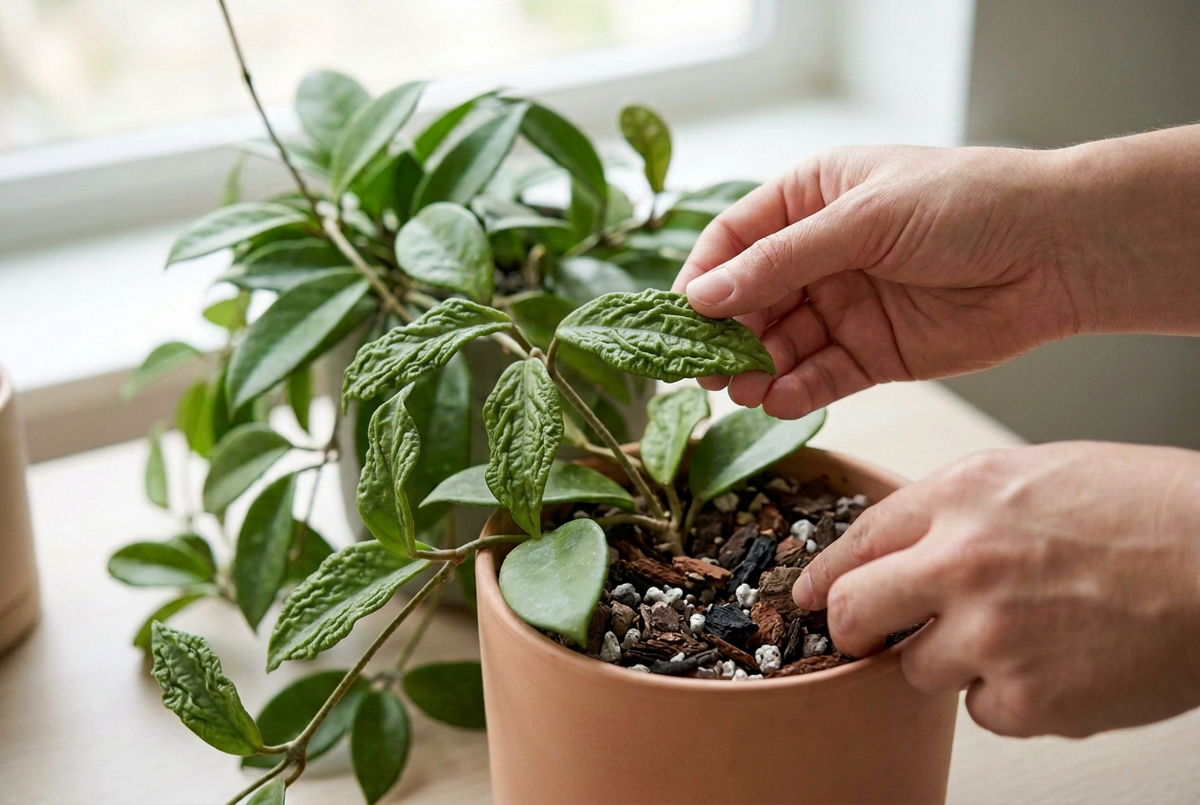
Why Are My Hoya Leaves Wrinkled? Causes and Easy Fixes
You love your Hoya. Its beautiful leaves, unique patterns, and trailing vines make it one of your favorite houseplants. But one day, you notice something unusual.
The leaves that once looked thick, firm, and healthy are starting to wrinkle.
Naturally, your first thought might be:
“Does my Hoya need more water?”
Surprisingly, the answer isn't always yes.
Wrinkled Hoya leaves can be caused by underwatering, but they can also indicate root damage, overwatering, temperature stress, or problems with the growing medium.
And here's the tricky part: an underwatered Hoya and a Hoya suffering from root rot can sometimes look almost identical.
Understanding the difference is important because choosing the wrong treatment may make the problem worse.
In this guide, we'll explain why Hoya leaves become wrinkled, how to identify the cause, and what you can do to help your plant recover.
What Do Wrinkled Hoya Leaves Mean?
Many Hoya species have thick, waxy leaves that store moisture.
When healthy and properly hydrated, these leaves generally feel firm and maintain their natural shape.
When the plant loses more water than its roots can replace, the leaves may begin to lose firmness.
You might notice:
-
Wrinkled or shriveled leaf surfaces
-
Leaves becoming thinner than usual
-
Soft or flexible foliage
-
Curling leaves
-
Drooping vines
-
Leaves losing their glossy appearance
-
Yellowing or falling leaves in more serious cases
These symptoms usually indicate that the plant is experiencing some form of water imbalance.
However, that doesn't necessarily mean the growing medium is too dry.
Sometimes, water is available, but the roots are too damaged to absorb it.
This is why checking the growing medium and root condition is the first step.
1. Underwatering: Your Hoya Is Too Dry
Underwatering is one of the most common reasons Hoya leaves become wrinkled.
Many Hoyas tolerate some drying between waterings, especially those with thicker leaves.
However, allowing the roots to remain excessively dry for too long can cause moisture stress.
As the plant begins using the water stored in its leaves, those leaves may gradually become softer and more wrinkled.
Signs of an Underwatered Hoya
-
The growing medium feels very dry.
-
The pot feels unusually lightweight.
-
Leaves feel thinner or softer than normal.
-
Several leaves begin wrinkling.
-
The vines may look slightly limp.
-
Roots may appear dry or shriveled if dehydration has been prolonged.
How to Fix an Underwatered Hoya
Start by checking how dry the growing medium is.
If the medium is dry and the roots appear healthy, water thoroughly until the root zone is evenly moistened.
Allow any excess water to drain completely.
If the potting medium has become so dry that water runs straight through without being absorbed, rehydrate it carefully and confirm that the root zone is actually receiving moisture.
After watering, observe your Hoya over the following days.
Leaves affected by mild dehydration may gradually regain firmness.
However, severely damaged leaves may not return completely to their previous appearance.
Important: Avoid repeatedly watering the plant just because the leaves haven't recovered immediately. Give the roots time to absorb moisture and assess their condition.
2. Overwatering and Root Rot
This is where many Hoya owners become confused.
Your Hoya's leaves are wrinkled, so you water the plant.
But the leaves remain wrinkled, and the situation continues getting worse.
Why?
Because the problem may not be a lack of water. It may be that the roots cannot absorb water properly.
When growing media remain excessively wet, oxygen availability around the roots decreases.
Over time, roots may deteriorate or develop rot.
Damaged roots cannot efficiently absorb and transport water, leaving the foliage dehydrated even when the potting mix is wet.
Signs of Root Rot in Hoya
-
Wrinkled leaves despite wet growing media
-
Yellowing leaves
-
Soft or collapsing stems
-
Potting mix remaining wet unusually long
-
Unpleasant smell from the root zone
-
Roots becoming mushy or decayed
-
Leaves dropping despite frequent watering
How to Check the Roots
If your Hoya remains wrinkled even though the medium is moist, gently inspect the root system.
Healthy Hoya roots are generally firm, although their natural color varies by species, age, and growing medium.
Damaged roots may become soft, hollow, mushy, or easily break apart.
How to Fix Root Rot
If you discover root damage:
-
Gently remove the plant from its pot.
-
Remove any decaying growing medium.
-
Inspect the root system carefully.
-
Trim clearly rotten roots using clean tools.
-
Repot into a suitable, airy growing medium.
-
Use a container with proper drainage.
-
Adjust watering to the plant's remaining root system.
If the root system is severely damaged, consider propagating healthy stem sections as a backup.
Recovering Hoyas may need time to establish new roots before their foliage becomes firm again.
Never assume that wrinkled leaves automatically mean your Hoya needs more water.
3. Your Growing Medium May Be the Problem
Hoyas need more than just water. Their roots also need oxygen.
Many cultivated Hoyas, particularly epiphytic species, perform well in airy growing media that drain efficiently while retaining an appropriate amount of moisture.
A growing medium that is too dense may stay wet for long periods.
On the other hand, an excessively coarse or water-repellent medium may dry too quickly or fail to absorb water evenly.
Both situations can contribute to wrinkled leaves.
Signs of an Unsuitable Growing Medium
-
Water drains immediately without wetting the root zone.
-
The medium stays wet for an unusually long time.
-
The medium has become compacted.
-
Roots are declining.
-
The plant repeatedly becomes dehydrated.
-
New growth is weak or slow.
What Is a Good Hoya Growing Mix?
A suitable Hoya mix may contain:
-
Orchid bark
-
Perlite
-
Coco chips
-
Pumice
-
A moisture-retaining organic component
The ideal ratio depends on the species, temperature, humidity, container, and watering routine.
For example, a thick-leaved Hoya growing in a humid greenhouse may need a different mix from a thin-leaved Hoya growing inside a dry home.
The goal is to provide enough moisture without suffocating the roots.
4. Temperature and Humidity Stress
Hoyas are tropical plants, but different species have different environmental preferences.
Many commonly cultivated Hoyas grow well in warm, stable indoor environments.
However, excessive heat, cold drafts, and very dry air can increase stress and affect water balance.
Heat Stress
During hot weather, leaves may lose moisture faster than the roots can replace it.
This is especially likely when the plant is exposed to intense sunlight or hot, dry air.
Low Humidity
Very dry indoor air may contribute to faster moisture loss, particularly for thin-leaved Hoya species.
Low humidity alone isn't always responsible for wrinkled leaves, so check watering and root health first.
Cold Stress
Hoyas may experience stress when exposed to temperatures below their preferred range.
Cold conditions can slow root activity and increase the risk of damage, particularly when growing media remain wet.
How to Fix Environmental Stress
-
Place your Hoya in a stable environment.
-
Avoid direct airflow from heaters or air conditioners.
-
Protect the plant from cold drafts.
-
Provide suitable bright, indirect light.
-
Maintain humidity appropriate to the species.
-
Ensure gentle airflow around the foliage.
Avoid making several dramatic changes at once.
Stable growing conditions are often more helpful than constantly moving the plant.
5. Shipping Stress and Acclimation
If you've recently purchased a Hoya online, especially an imported one, wrinkled leaves may be related to shipping stress.
During shipping, plants can experience:
-
Limited light
-
Temperature changes
-
Restricted access to water
-
Root disturbance
-
Changes in humidity
-
Handling stress
-
An extended period in packaging
Some degree of moisture stress can occur during transportation.
However, severely wrinkled leaves may also indicate that the root system has been affected.
What to Do When Your Hoya Arrives With Wrinkled Leaves
Step 1: Inspect the plant.
Carefully unpack the Hoya and examine the leaves, stems, and roots where accessible.
Step 2: Check the roots.
Determine whether the roots are healthy, dry, or damaged.
Step 3: Provide stable conditions.
Place the plant in suitable indirect light, away from extreme heat or cold.
Step 4: Water according to root condition.
Do not automatically water heavily if the roots are damaged or the medium is already wet.
Step 5: Avoid unnecessary fertilizer.
Focus first on root recovery and acclimation.
Step 6: Monitor new growth.
Healthy new roots and leaves are positive signs that the Hoya is establishing itself.
Not every imported Hoya will recover at the same speed. Some recover quickly, while others require more time.
A stable environment and careful observation are essential.
6. Pests May Be Affecting Your Hoya
Pests can weaken Hoya plants by feeding on their tissues.
Although wrinkled leaves are more commonly associated with water or root problems, pest infestations can also contribute to declining plant health.
Common Hoya pests include:
-
Mealybugs
-
Scale insects
-
Spider mites
-
Aphids
Signs of Pest Problems
Look for:
-
White cotton-like insects
-
Sticky residue on leaves
-
Tiny moving pests
-
Fine webbing
-
Yellow speckling
-
Distorted new leaves
-
Declining growth
How to Fix It
Inspect both sides of the leaves, stems, nodes, and new growth.
If pests are present, isolate the affected plant from the rest of your collection.
Choose an appropriate treatment labeled for the identified pest and suitable for the plant, following its instructions.
Continue monitoring until the infestation is controlled.
Avoid using overly strong or untested homemade chemical mixtures, which may damage sensitive foliage.
7. Fertilizer Buildup or Restricted Roots
Sometimes, the problem is related to the root environment rather than watering frequency.
Excessive fertilizer can cause soluble salts to accumulate in the growing medium.
High salt concentrations can damage roots and interfere with water absorption.
Likewise, a severely overcrowded root system may leave little growing medium available to retain moisture.
Signs to Watch For
-
Browning leaf tips
-
Slow or weak growth
-
Root damage
-
White mineral deposits on the medium
-
Very rapid drying after watering
-
Wrinkled leaves despite an apparently normal routine
How to Fix It
Avoid applying extra fertilizer to a stressed plant.
Check the growing medium and roots.
If salt buildup is suspected, flushing an otherwise well-draining medium with plain water may help, provided the roots can tolerate it.
If the plant has substantially outgrown its container, consider repotting into a slightly larger pot with fresh growing medium.
The goal is to restore a healthy root environment.
How to Tell Whether Your Hoya Needs Water or Has Root Rot
This is the most important step in diagnosing wrinkled Hoya leaves.
If the Medium Is Dry
Check whether the roots and stems are healthy.
If the roots remain firm and the plant shows signs of dehydration, thorough watering may help.
If the Medium Is Wet
Do not immediately add more water.
Check drainage and consider inspecting the roots, especially if the plant continues declining.
Wrinkled leaves combined with persistently wet medium may indicate root damage.
If the Medium Is Moist but the Leaves Remain Wrinkled
Consider other factors such as:
-
Recent shipping
-
Root disturbance
-
Excessive heat
-
Damaged roots
-
Pest infestations
-
Growing medium problems
Treating the cause is much more effective than repeatedly watering the plant without understanding what's happening.
Can Wrinkled Hoya Leaves Become Firm Again?
Yes, depending on the cause and the amount of damage.
If the leaves have become wrinkled because of mild underwatering and the roots are healthy, they may regain firmness after proper hydration.
However, recovery may be slower when root damage is involved.
Some leaves that have experienced severe dehydration or tissue damage may never return completely to their original appearance.
Even if older leaves remain imperfect, healthy new growth is a positive sign.
Focus on helping your Hoya establish healthy roots and produce new foliage.
How Long Does It Take for Wrinkled Hoya Leaves to Recover?
There is no guaranteed recovery time.
For mild dehydration, some leaves may begin to feel firmer within a few days after the roots receive sufficient moisture.
When root rot or significant root loss is involved, recovery may take much longer because the plant needs to regenerate functional roots.
A heavily stressed plant may also lose some leaves during recovery.
Rather than expecting an immediate transformation, monitor:
-
Root development
-
Stem firmness
-
Leaf condition
-
New growth
-
Overall plant stability
Consistent improvement is more important than achieving a particular recovery timeline.
Do All Hoya Species Show Wrinkling in the Same Way?
No.
Hoya is a diverse genus, and different species have different leaf structures.
Thick-leaved Hoyas may store more moisture than species with thin or delicate foliage.
For example, commonly grown thick-leaved Hoyas such as Hoya carnosa may show a noticeable loss of firmness during dehydration.
Thin-leaved types may respond differently and may not tolerate extended dryness as well.
Some Hoyas also have naturally curled, puckered, or textured foliage.
For example, Hoya carnosa 'Compacta' has naturally twisted leaves, so its normal appearance shouldn't be confused with dehydration.
Always consider the species' natural appearance before diagnosing wrinkling as a health problem.
How to Prevent Wrinkled Hoya Leaves
Prevention starts with healthy roots and a consistent growing environment.
Choose the Right Growing Medium
Use a mix that offers adequate drainage, aeration, and moisture retention for your Hoya species.
Check Before Watering
Do not rely on a fixed watering schedule.
Check the moisture level of the growing medium and consider the plant's environment.
Provide Appropriate Light
Many Hoyas thrive in bright indirect light.
Adequate light supports healthy growth and helps the plant use water efficiently.
Avoid Extreme Temperatures
Protect Hoyas from excessive heat, cold drafts, and sudden temperature changes.
Check Roots When Problems Continue
If leaves remain wrinkled despite appropriate watering, investigate the root system.
Inspect for Pests
Regularly examine new growth and the undersides of leaves.
Give Newly Shipped Hoyas Time
After shipping, focus on stable growing conditions and root health rather than aggressive treatments.
Choosing a Healthy Hoya Before Buying
If you're buying a rare Hoya online, understanding plant health can help you make better decisions.
Before purchasing, consider:
-
Root establishment
-
Stem condition
-
Leaf firmness
-
Growth point condition
-
Plant maturity
-
Acclimation status
-
Shipping method
-
Seller experience
For collectors, beautiful leaves are important, but healthy roots and stems are even more valuable.
A well-established Hoya has a stronger foundation for growth after shipping.
Discover Rare Hoya Plants at Aroid Market
Hoyas are among the most fascinating tropical plants to collect.
From thick, waxy foliage to unusual textures, silver patterns, splash markings, variegation, and beautiful flowers, every Hoya offers something different.
At Aroid Market, we offer a diverse selection of rare and collectible tropical plants from Indonesia, including Hoya species and collector varieties.
Whether you're interested in Hoya carnosa, Hoya lacunosa, Hoya latifolia, or more unusual collector selections, understanding their care requirements can help you enjoy them for years to come.
For customers in the United States, Aroid Market also simplifies international purchasing through our USA forwarding arrangement.
Our team coordinates the import process, allowing eligible USA customers to purchase without arranging their own import permit or customs brokerage.
If you enjoy collecting Hoyas, take your time exploring different species and choosing plants that match your growing environment.
Discover our Hoya collection at Aroid Market.
Frequently Asked Questions About Wrinkled Hoya Leaves
Why are my Hoya leaves wrinkled even after watering?
Your Hoya may have damaged roots that cannot absorb water efficiently. Check the growing medium and root condition before watering again.
Does wrinkled Hoya foliage mean root rot?
Not necessarily. Wrinkling can result from underwatering, root rot, temperature stress, or other problems. The condition of the growing medium and roots helps identify the cause.
Should I water my Hoya immediately if the leaves are wrinkled?
Only after checking the growing medium. If the medium is dry and roots are healthy, watering may help. If the medium is already wet, inspect for other problems first.
Can overwatering cause Hoya leaves to wrinkle?
Yes. Excessively wet growing media can damage roots, preventing the plant from absorbing sufficient water.
Will wrinkled Hoya leaves recover?
Some leaves recover when the cause is corrected, especially after mild dehydration. Severely damaged leaves may remain wrinkled.
Why are my Hoya leaves soft and thin?
Soft or thin leaves may indicate dehydration, but the underlying cause may be dry growing media or roots that are unable to absorb water properly.
Why are my Hoya leaves wrinkled after shipping?
Shipping can expose plants to dehydration, environmental changes, and root stress. Inspect the plant carefully and provide stable conditions during acclimation.
Can low humidity make Hoya leaves wrinkle?
Very low humidity may contribute to moisture stress, particularly for thin-leaved species. However, watering and root condition should be checked first.
How often should I water my Hoya?
There is no universal schedule. Watering frequency depends on the species, growing medium, pot size, temperature, humidity, and light. Check the growing medium rather than watering by the calendar.
Final Thoughts: Healthy Roots Are the Key to Healthy Hoya Leaves
Wrinkled Hoya leaves can look worrying, especially when the plant is part of a rare collection.
But the solution doesn't always involve adding more water.
Sometimes, the plant is simply thirsty. Other times, it may be struggling because of root damage, an unsuitable growing medium, or environmental stress.
The most important thing is understanding what your Hoya is telling you.
Check the growing medium, examine the roots when necessary, and make careful adjustments based on the actual problem.
With healthy roots, suitable conditions, and consistent care, many Hoyas can recover and continue producing beautiful foliage.
And when you're ready to expand your collection, explore the diversity of rare Hoyas from Indonesia at AroidMarket.com.

Written by Aroid Market
Leave a comment
This site is protected by hCaptcha and the hCaptcha Privacy Policy and Terms of Service apply.